Acorn Bank Watermill Blog
Acorn Bank Garden and Watermill is located at Temple Sowerby, around six miles east of the town of Penrith. The garden and watermill are owned by the National Trust. The watermill is being restored by a team of volunteers, one of whom is recording the work and other mill-related activities in this blog
Tuesday, 22 May 2012
A new handle
While Bob was operating the mill on Sunday, the handle of the shutter next to the gate valve came off in his hand. Inspection showed that there had been a knot in the wood at just the point of maximum stress. Today Ray and Bob made a new, overengineered, handle. The design was mainly to avoid having to dismantle the whole assembly to remove the shutter. They can be seen above putting the screws in.
Meanwhile George was getting on with the pointing.
Note that, entirely by accident, none of today's pictures shows anyone's face.
Monday, 14 May 2012
National Mills weekend 2012
We were open and milling all day Saturday and Sunday for Mills Weekend. The weather was very favourable on Saturday, Sunday was gloomier but at least it didn't rain.
Garden volunteer Janice's husband, a professional baker, had taken away some of our flour and baked some superb bread both for tasting and for people to buy. Some of the (100% wholemeal) flour was mixed with Little Salkeld unbleached white flour, some was used on its own. It was a roaring success, and sold out completely.
Meanwhile we kept the stones turning and bagged and boxed lots of flour. The 500g bags were offered to visitors for a donation. Overall I estimate almost a hundred of them went. Since last Tuesday we have milled 150kg of wheat - not sure how much we wore on our clothes!
Wednesday, 9 May 2012
At last it can be told!
At the end of last year, we submitted an entry for the Marsh Heritage Award. This Award, run by the Marsh Christian Trust in partnership with the National Trust, "recognises the
contribution of groups of volunteers who work tirelessly for the
nation's heritage".
We are delighted to be able to reveal that we won the award, coming first of the nineteen entries from Trust properties all over the country.
We have known about this for a while, but we were asked to maintain a diplomatic silence until all the other entrants had been informed.
We were congratulated at the mill on April 1st by a volunteer member of the National Trust Council, Roseanne Williams, who sent us this photo of her with Bob. There will be a formal presentation later in the year.
Tuesday, 8 May 2012
Milling again
| Two of the curved wedges for the axletree bearing... |
| ... and one of them in situ |
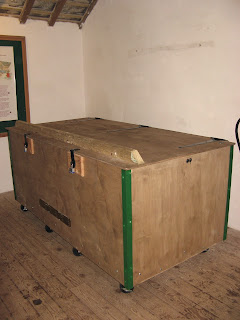
Meanwhile, Ray was putting the finishing touches to the grain storage bin. It has three separate lids, each of which is just lifted off the box (no hinges!) There is also a ventilator, with internal insect screen; another one is to be added when we have obtained another ventilator grille.
George was usefully employed applying some lime mortar to the joint pointing in the launder support piers. This morning, Bob went to Little Salkeld watermill and obtained 100kg of wheat and a few hundred flour bags - thanks again, Nick.
In the afternoon we started the mill and eventually got the water flow, grain feed and stone separation set correctly so that we were producing decent flour. There are still some whole grains bouncing off the damsel and missing the milling process, but we made a sieve of suitable grade to remove them from the meal. At the quantities we are producing it isn't a problem to sieve all the product.
We then made up the meal into 500g sample bags, about 16 in all by the end of the day.
| Richard tests the product |
| Our very first bagged flour! |
Tuesday, 1 May 2012
Good to be back
Well, I've been away on family business / holiday for the last 3 Tuesdays - sorry to have disappointed our regular readers. To make things worse, I forgot the camera today, so this is the grown-up version without pictures!
While I've been away the others have almost completed the grain bin, the trash strainer is in place on the sluice, and the slack bearing on the end of the axletree has been wedged and now runs silently.
Today more work on the lid of the grain bin - aluminium lined like the rest of it. We also cut a hole in the lid of one of our "Really Useful Boxes" so that it fitted round the flour chute, and made a small stand so the box in question would sit at the right height to collect flour.
Later, we dismantled the tun, lifted the runner stone by 6 inches or so, and had a good hoover round in preparation for milling flour again. Then we put it all back together.
While I've been away the others have almost completed the grain bin, the trash strainer is in place on the sluice, and the slack bearing on the end of the axletree has been wedged and now runs silently.
Today more work on the lid of the grain bin - aluminium lined like the rest of it. We also cut a hole in the lid of one of our "Really Useful Boxes" so that it fitted round the flour chute, and made a small stand so the box in question would sit at the right height to collect flour.
Later, we dismantled the tun, lifted the runner stone by 6 inches or so, and had a good hoover round in preparation for milling flour again. Then we put it all back together.
Wednesday, 4 April 2012
Grain bin and trash strainer progress
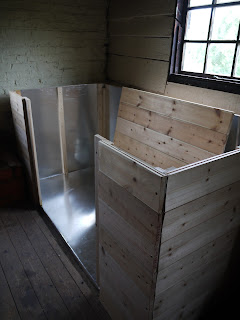
More work on the grain bin; Ray continued the woodwork, and we made a change to the design when Bob pointed out that with sides 1 metre high he, at least, would find it difficult to get the bags out. The box is now to be 70cm high. The base was completed by having its sheet of aluminium glued in place. Another plywood panel, intended to be the ends, also had its aluminium attached and was sawn to height.

The fixing plates for the trash strainer grid were finally ready after painting, so the grid was assembled and now only needs to be dropped into the guides bolted to the sluice.

Fixing the first sheet of aluminium lining
The fixing plates for the trash strainer grid were finally ready after painting, so the grid was assembled and now only needs to be dropped into the guides bolted to the sluice.
The completed trash strainer grid
Tuesday, 27 March 2012
How heavy is the axletree exactly?
Aren't the daffodils lovely?
The main task today was to continue trying to sort out the loose bearing due to timber shrinkage on the end of the axletree. Martin Watts has recommended that we should use a number of very thin oak wedges. Richard reckoned that it would be easier to make sure the pintle stays centred if we either took the load off it, or drove in 9 or 10mm metal bars first and then wedged around them.
We therefore tried again to lift the indoor end of the axletree. This time we used 2 3-tonne chain blocks each with appropriate straps, each attached to a separate oak beam. Bob pulled on the two blocks simultaneously and monitored the tension in the chains, Richard watched the pintle and Ray watched the two beams. Eventually it was Ray who called that the narrower beam was bending. The pintle hadn't moved and the lifting chains were as stiff as steel bars. Given that we were lifting at one end of the axle, we should have been able to lift a distributed load of 12 tonnes, unless something was jammed. What is going on?
The heavy lifting arrangement
Elesewhere work on the grain store and the trash strainer continued. Ray fitted castors to the grain store frame, and Bob primed and painted the angle-iron corners, as well as the parts for the trash strainer.
The grain store makes more progress
Subscribe to:
Posts (Atom)