Here, with the kind permission of BBC Look North for North east and Cumbria, is the TV news report about the mill, broadcast on Wednesday 12th October. Our thanks go to their Colin Richardson.
Monday, 17 October 2011


Tuesday, 11 October 2011
Milling again
Today we were inundated by BBC reporters, well, two of them anyway. First a radio man with a fancy recording microphone, then a TV man with a very fancy Sony camera. They both spent a couple of hours with us, interviewing, recording and watching us mill our second batch of flour - the first time we have milled on our own. The TV report was supposed to go out on Tuesday evening on Look North, but it didn't. Someone told me it went out on Wednesday lunchtime, and it certainly went out on Wednesday evening. The radio report was due to go out on Wednesday morning, but as I can only get digital radio, and Radio Cumbria only does FM, I have no idea whether it did.
The milling was successful, however, and we ended up with a few more Kg of smooth flour even after we had given samples to the BBC men.
The milling was successful, however, and we ended up with a few more Kg of smooth flour even after we had given samples to the BBC men.
Later, we finished the work on the new dump valve system. As the video shows, it worked quite well at first, though we later had to remove some of the rubber seal around the dump valve, as water pressure drove it into the mechanism, causing it to jam.
Tuesday, 4 October 2011
Developing the water control
 During the last week, Richard had fabricated a superb, flexible hinge arrangement for the new second lever on the dump valve. Today we installed the hinge, with the new lever, through a new hole in the weatherboarding wall. The hinge is mounted on the weatherboarding, which is reinforced by a large plank screwed across several boards. There is adjustment of the axis of the hinge relative to the wall, to allow for the slight skew angle of the launder.
We then made the two-piece link to join the new lever to the old, assembled the whole thing (apart from the actual shutter board) and tested it. This short video shows how the new lever moves further than the old one, as intended.
At last this damned Blogger interface has let me upload it.
 Elsewhere, we also fitted a couple of small pulleys to re-route the cord controlling the angle of the shoe so that it can be adjusted from the lower floor.
The following day, Wednesday 5th October, Richard and Bob returned to the mill, lured by the prospect of a visit by the BBC - which, typically of the media, never happened. However, we did manage to test the new shutter with the board rigged approximately in place and to clear some of the woodland debris from the headrace. Richard also made a number of measurements for his ongoing home fabrications.
Thursday, 29 September 2011
Improving waterwheel control
While Nick Jones was helping us to mill our first flour last week, he observed that we could do with a bit more power from the wheel, as well as the ability to control wheel speed from inside the mill. This control might be done by the dump valve, a board we can drop out of the bottom of the launder. We also noted that the dump valve was not effective as an emergency stop when the water flow was high - enough water just 'toboggans' over the dropped flap to keep the wheel turning.
So today we set about improving the action of the dump valve. The options were either to make a second board drop, doubling the width of the gap, or to link a vertical board to the dump valve mechanism so that it forms a block across the launder just below the dump valve. Dropping a second board would be a major engineering project, so we concentrated on the second option. The main difficulty was that the available lifting motion from the dump valve mechanism at the point where the new board needs to fit was only about 9cm, and we would need nearer 20cm.
 After exploring many ideas, we concluded that the only way to generate the extra movement is to use a second lever linked to the dump valve actuator with its own separate pivot. We cobbled together an experimental rig using a hoe handle with its pivot in the weatherboard wall of the wheel shed to check the theory and it worked, as the pictures show. Parts of the permanent mechanism will be made over the next few weeks.

We also noted several issues that may affect the efficiency and power of the waterwheel. Firstly, it leaks badly, and stopping water escaping from the buckets would increase power. Secondly water splashes out of the first bucket due to the height from which it falls from the launder. The side cheeks we noted at New Abbey might help, however we also noted that the end of the launder is not parallel to the axis of the wheel. Finally, as the wheel is pitchback, the water falling from the launder is moving in the opposite direction to the wheel and therefore its horizontal momentum will act as a brake. We began to design a box for the end of the launder to reverse the direction of the final fall of water.
Tuesday, 20 September 2011
Flour!!!
At last, after 4 years of work, we finally milled!
This was the first time since at least 1940 the mill has produced flour.

We arrived early to make sure all was well, and made a few minor changes and adjustments. Nick Jones, from Little Salkeld watermill, arrived with two sacks each containing 25kg of grain. After a few further checks, he took us through the process of starting up for the first time. A lot to learn, from how to untie the paper sacks easily rather than fighting them, to balancing wheel speed and grain flow rate to get a good product.
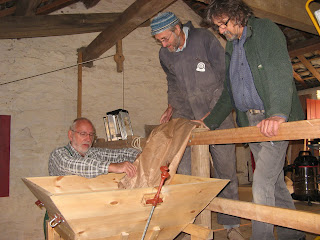
In the event the product was proclaimed to be good and the whole thing worked smoothly, surprisingly so for a first run. We had a small celebration and carried on milling for a couple of hours. Nick reckoned the system could be run faster to increase output, but that isn't really a problem for us, we don't want tons of the stuff!
This was the first time since at least 1940 the mill has produced flour.

We make the final adjustments...
We arrived early to make sure all was well, and made a few minor changes and adjustments. Nick Jones, from Little Salkeld watermill, arrived with two sacks each containing 25kg of grain. After a few further checks, he took us through the process of starting up for the first time. A lot to learn, from how to untie the paper sacks easily rather than fighting them, to balancing wheel speed and grain flow rate to get a good product.

...before Nick Jones arrives
to fill the grain hopper
to fill the grain hopper
In the event the product was proclaimed to be good and the whole thing worked smoothly, surprisingly so for a first run. We had a small celebration and carried on milling for a couple of hours. Nick reckoned the system could be run faster to increase output, but that isn't really a problem for us, we don't want tons of the stuff!
The short video shows some of the bits of the process in action, with nice mechanical sounds.
Monday, 19 September 2011
Visit to New Abbey Mill, Dumfries

The New Abbey waterwheel

The stone floor
This year's Acorn Bank staff and volunteer outing took us to New Abbey Mill (also to Threave garden, a very interesting and pleasant place, but a garden blogger will have to write about that).
New Abbey Mill is a single wheeled watermill with 3 pairs of stones. Unfortunately, it is unable to work at present due to bearing problems with one of the stones. We were, therefore, only able to see it in action on the excellent 12 minute video. The guide was well informed and humorous - as a result Chris Braithwaite said that we ought to be funnier!
Among useful and interesting things we saw at New Abbey were: control of the wheel speed from the milling area by means of a diverter (our "dump valve"); the complete drying kiln; the Heath-Robinson sack hoist; the side cheeks under the launder to prevent water spilling sideways out of the wheel.
Thanks to Sara for organising the trip and providing us with tea and cakes at Threave.

A pretty, and wet, flower
at Threave
Tuesday, 13 September 2011
Good progress!

Ray and Richard examine the
finished flour chute
The flour chute is finished at last! Ray finally made the front covers, one of which is hinged for access to clean the inside. It will also allow the fall of flour to be seen - one of the issues with preparing the mill for milling is that all the interesting mechanical bits get covered up. We then sanded and cleaned the whole thing, sealed the inside joints with food grade silicon sealant, and applied some wood stain to the outside to prevent it looking too "new".
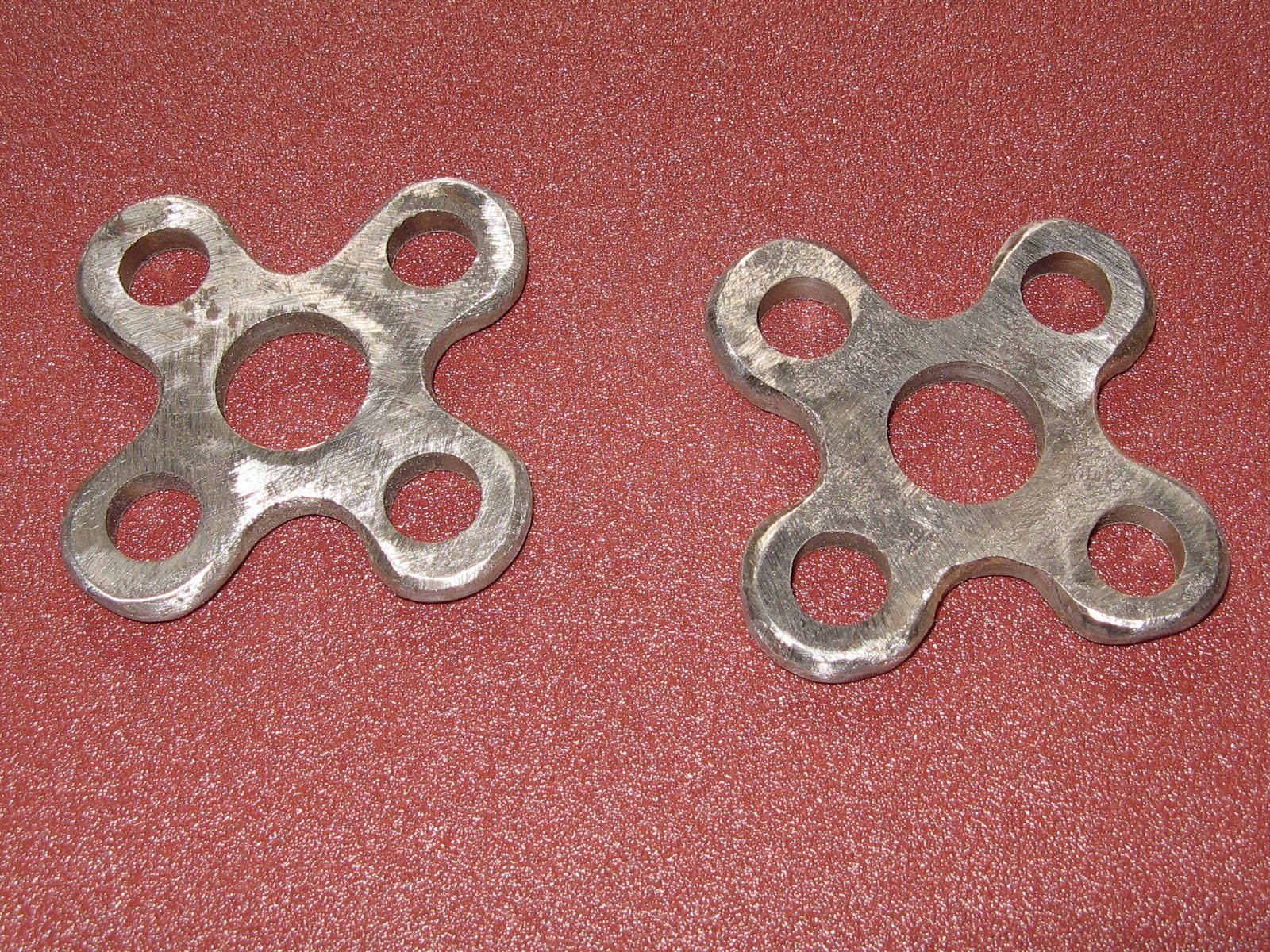
Richard carried on with making the parts for the damsel. This picture shows the top and bottom plates which will mount on the damsel shaft and carry the 4 bars making the eccentric to agitate the shoe.

The greenhouse window winder

Oak in the wrong place
After lunch we scrounged some nice mechanical bits from the window opening system in the old greenhouse, which has been demolished to make way for a fancy new one. The screw drive looks as if it would make a fine remote actuator for the gate valve, so the miller can control the water flow, and hence wheel speed, from within the mill.
Progress was held up a bit by the large oak branch that the gales had blown down on the path to the house.
Progress was held up a bit by the large oak branch that the gales had blown down on the path to the house.
Subscribe to:
Posts (Atom)