Wednesday, 3 April 2013

Tidying up the launder area

The launder has gone together slightly different that the previous version, so we have had to make one or two adaptations, including to the gate valve.

We have now finished the work on the launder, apart from the pointing (which we still can't do as the weather remains stubbornly below the required 5 degrees) and stopping up one or two leaks (also difficult at present temperatures).  It has been the coldest March for 66 years, apparently.

We therefore began tidying up by removing a lot of the rubble, sacks and bags we had been using or had left about. We also began to replace and repair the fencing.  As you can see, the section of fence alongside the steps is now back in place, as is the guard rail for the gate valve adjusting platform and part of the temporary fence has been removed.

Tuesday, 26 March 2013

Easter coming up, and still snowing

We were joined today by a new mill volunteer - welcome, Lesley! She rapidly got stuck in to cleaning and tidying part of the workshop. Ray was still snowed in in Weardale.

Meanwhile we managed to do some finishing off outside.  We replaced the little bit of fence from the launder to the wall next to the kiln door (back left corner of this picture) and finished off the new fence between the launder and the spillway pit.

George re-bedded the new spillway stone, which had come adrift in the frosts.  We generally tidied things up, hoping to be able to turn the machine over Easter weekend.  We will not be milling for a few more weeks.

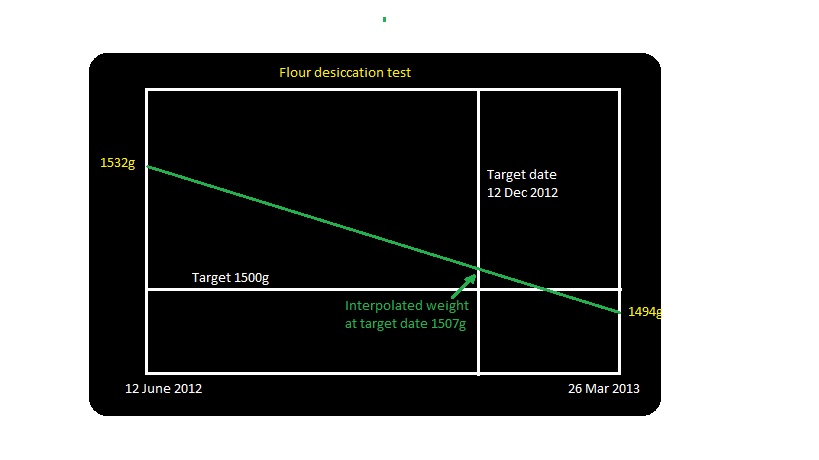
We also completed the flour desiccation test - we bagged 1532g of flour in June 2012 and I have kept it at home to see how much weight it loses by drying out over its 6 month shelf life.  We meant to weigh it again in December, but weather and other stuff was against us, so we did it today and interpolated the weight at 6 months.  It was OK, so we know we need to continue bagging 1530g of flour in our 1.5kg bags.

Tuesday, 19 March 2013

Mud and fencing

 Today the estate staff (Robert, Sam the lone ranger, and Jim the volunteer) cleared muck from the major part of the headrace.  Here you can see the resulting mucky bank.

There was no Ray (snowed in again), but the rest of us got on with fitting the metal post sockets for the new fence alongside the spillway pit.


Tuesday, 12 March 2013

Mud, glorious mud


 The Friday team had finished the launder boarding last week, but there is still a lot of pointing to do.  As the pictures show, it wasn't the weather for it - snow, bitterly cold, and more of the same forecast.

So we started work on clearing the silt and leaves from the headrace.  Breaking the ice and scooping out 6 to 10 inches of slimy, smelly mud, and disposing of it down the bank, proved to be back-breaking work.
 At the end of  the day (or at least as much of it as we could cope with), we had done at least something towards clearing about 30 metres.  Just another 400 to go.

Tuesday, 5 March 2013

Reboarding the launder

 The launder is coming on nicely now, after Richard and others put in an extra day last Friday.  You can see in the picture how far they had got, and more progress was made today.  You can also see George in the background replacing the rail on the fence over the pit near the wheelhouse.

Peter and I continued preparing the larch boards for the launder, and brushing and painting the control lever for the gate valve.

The way the launder is being constructed can be seen here.  The side beams are 50mm thick oak, with the joining pieces made of the same and bolted on.  The bottom boards are 40mm thick larch, 40 inches long by about 10 inches wide (sorry about the mixed units, but those are the measurements that work!),  rebated 20mm x 20mm along each long edge to give a stepped joint.  The joints between boards and under the side beams are sealed with Roofer's Mate, which dries to a nice, inert, rubbery gasket.  The boards are screwed from underneath using Screwfix M8 x 70mm Turbo Coach Screws.  As you can also see in the picture, we have protected the core of the stone piers from any leakage water by reusing squares of the old plastic pond liner.

Wednesday, 27 February 2013

Solid progress with the launder

 I missed a week last week because of an achilles tendon injury, but back this week even if not fully mobile.  We had  a new starter, Peter, who spent the day helping me to prepare the bottom boards for the launder - putting the step in the edge of each one, cutting to length and drilling the 4 holes for the fixing screws.  This means there are now 44 of them, most of them ready for fitting in the launder, some with a few holes to drill.

Mike did a lot of (overdue) tidying in the wood store.

Richard and Ray did an extra day last week, as a result of which the launder side beams were fully in place complete with joining pieces.
This week they set about restoring the sluice end of the launder.  The uprights were dowelled to the ends of the side beams...

 ... before the second upright was rebated and screwed into place.  These two make the slot in which the vertical blade shutter runs.
Finally the blade and the hinged "gate valve" were re-installed.  The mechanical parts of the launder are therefore almost complete.

Tuesday, 12 February 2013

Progress at last

The side supports tested in place, and
 hessian sacks cover the new mortar
At last the weather has been kind enough to allow us to move forward with the launder.

George repointed some of the launder piers' stonework  and began to rebuild the spillway. The mortar will need to be protected by hessian sacks from some of the frosts we are expecting over the next day or so.

Richard cut the new spillway stone to size; in that way bits of stone have, it also broke into two pieces, which will need to be thought about when we cement it/them in.  He carried on preparing the spillway end for building the launder.

Ray and Bob cut the steps into the edges of 20 of the larch boards for the bottom of the launder and trimmed them to length.

Finally we arranged two of the side supports for the sluice end of the launder, checked with a string line that they were lined up with the other end, and fixed one of the bottom boards.