Wednesday, 19 February 2014

Waterwheel rebuild - good progress

Ray planes bucket boards
 A good turnout of 7 volunteers today, so we were able to get on.  Ray, Bob and Donald continued making the bucket boards.  This involves ripping the boards to width, cutting at the required 54 degree angle; trimming them to length; drilling the bevelled edge for the joining screws and inserting and removing the screws (to make them easier to put in for real); and planing the edges to ease the fit into the wheel castings.

We now have 10 sets fully processed, and the remaining 20 sets are all ripped and waiting for length cutting and finishing.
Richard helps Bob locate the angle
of the bucket screws

Assembly has been made easier by drilling the clearance holes slightly bigger than is strictly necessary for the brass woodscrews we are using.


The tailrace is flooded
In spite of which several buckets
were installed

Richard and David managed to complete the installation of 7 buckets overall.  They have to be fitted a few at a time, then the wheel turned and some fitted at the opposite side.  Otherwise the weight of them would make the wheel dangerously unbalanced.

Finally, Peter and George got on with cobbling the area behind the wheelhouse; only a small area left to do.

Friday, 14 February 2014

Finally work starts on the wheel

Donald cuts some bucket
bottom boards

At last we were able to start rebuilding the waterwheel.  Using the new saw table to cut the 54 degree angles on the board edges, Bob and Donald produced the pairs of boards for 10 buckets - only 20 to go.  We then trimmed them to length.  The next stage is to fit them together in the jig (see last week) and drill them for the joining screws.  The leading edge of the bucket boards has to be rounded and the edges thinned to fit in the shroud castings.
The centre of this diagram shows how a pair of boards fit together, at an angle of 108 degrees, and meet the lining boards to form a bucket.  The outer part represents the 30 buckets and 40 lining boards forming the wheel.


Richard fits the first
of the new buckets
Richard took the first completed set and did the final trimming to fit it in the wheel.

Tuesday, 4 February 2014

Sawing at last

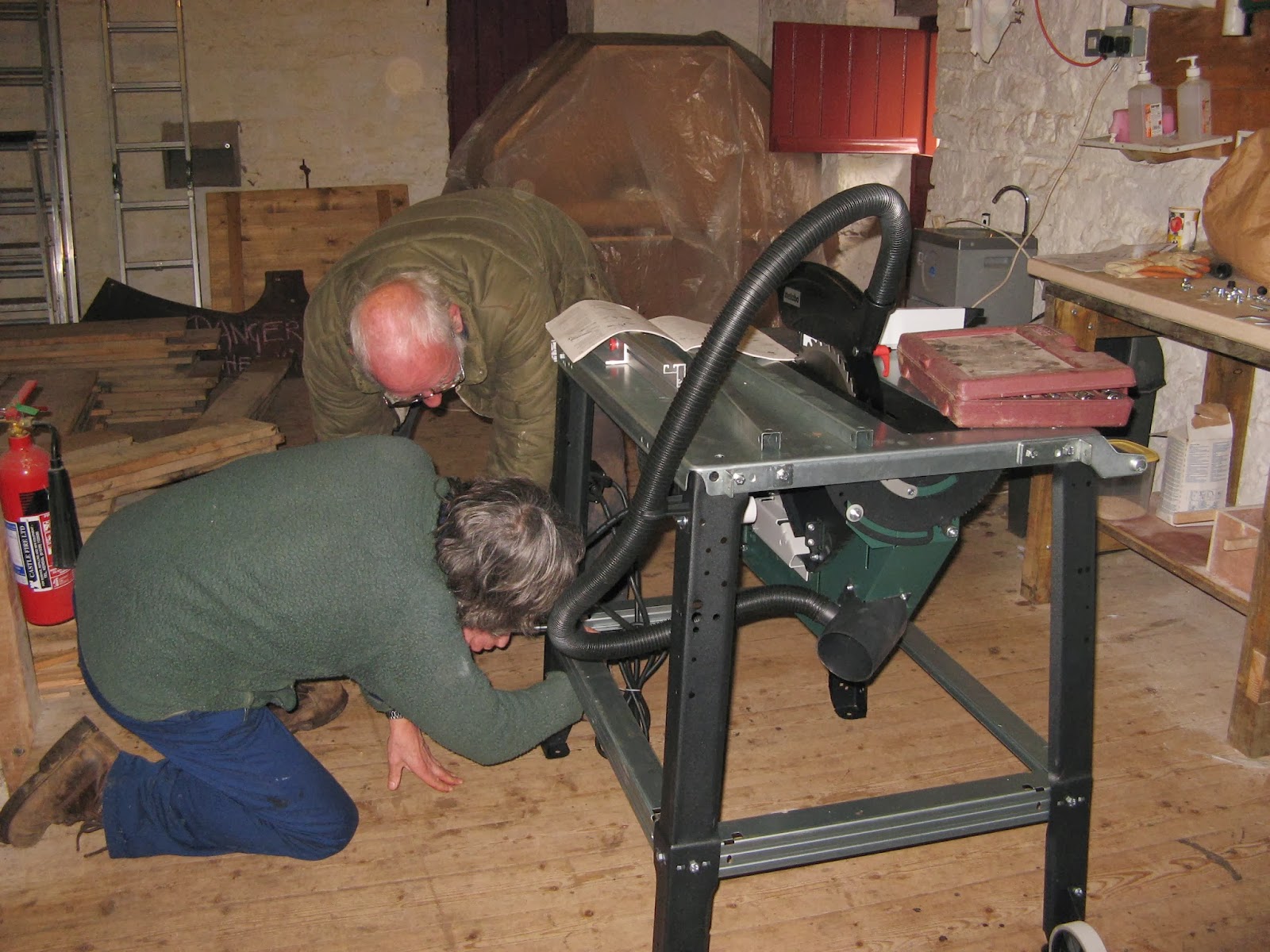
 Richard started the day by releasing a few waterwheel tie-bar nuts that hadn't been done before.  However, the main news was that the saw table had finally arrived.  It was agreed that it was only to be used by volunteers who had been approved by Ray - Bob, Richard and Donald all demonstrated their ability not to sever any limbs!
 The saw was impressively professional looking, and was also a big, heavy object, even though on;ly the table and motor came as a pre-assembled unit.  Eventually it was manhandled up the mill stairs and the boxes were opened. Once we had digested the rather complicated and, in places, vague instructions, it gradually began to take shape...
 ...until finally it was standing on its own feet and ready to run.  There were two minor issues, both components that were unduly flimsy for such a heavyweight piece of machinery: the little wheels that allow it to be moved were held on by weak circlips which pinged off whenever strain came on the axle; and the plastic butterfly nut that locks the saw angle control snapped off its metal core on first use.
Other than that, a successful start.  We cut some of the wheel boards to their 54 degree angle and mounted them on the jig Ray had made for their assembly.

Saturday, 1 February 2014

Still waiting for the saw table

George repoints the wheel pit
 This week we continued to prepare for re-boarding the wheel, as the saw table still hasn't arrived.  We took the last couple of dozen bucket boards back to the sawmill to be reduced to 25mm thick, and they are now all stored in the relative dry of the mill.

George has been standing at the bottom of the wheel, pointing the back wall of the wheel pit with hydraulic lime mortar, a job that can only be done while the wheel is entirely without boards.

All the bolts holding the wheel shrouds to the spokes have been loosened, and one on each spoke has been replaced by a length of studding, so that the shrouds can be moved apart.  A log, cut to length and with two hooks to enable it to be attached to the spacer bars, will be used with a bottle jack to force the shrouds apart.

Richard attaches a hoist
to the shrouds
The plan is for the shrouds to remain supported by the ends of the spokes, but just in case of mistakes we are attaching a hoist to take the weight.
A general view through the
stripped wheel


Thursday, 16 January 2014

Back after the Christmas break

Crowdundle Beck - lots of water!
Well, here we all are again.  The weather has been very wet and windy, and the season started with the Crowdundle Beck not obviously aware of its proper station in the world.  Instead it was high and frisky and pushing back up the tail race, immersing the bottom of the now naked waterwheel.
We continued, last week and this, to prepare the wheel for its new oak boards.  Fitting them will be a challenge, as the shrouds will have to be moved at least an inch apart to allow the boards to enter the slots in the casting.  The tie bar nuts have all been slackened, greased and re-tightened; a jig has been built to enable the boards to be assembled at just the right angle before being inserted in the wheel; another jig to measure the width of the boards and the size and position of the notch needed to accommodate another part of the casting.  There are a few bits of the casting that will need to be repaired.
The wheel, stripped for action
The boards themselves have been on order a while, and they all turned up this week - nearly all too thick to fit in the slots in the casting!  We agreed with the supplier to take them back in batches and re-thickness them with his planer.  Richard and Ray took the first batch, which now look OK.  We are also still waiting for our saw table, which is being bought with our Marsh Heritage Award money.
In the meantime, we have been doing some maintenance on the surroundings of the wheel, the bits that are inaccessible when the wheel is boarded.  The wooden lintel over the hole where the main shaft passes through the mill wall was completely rotten, so we replaced it; the new one will be protected by a piece of lead flashing to keep the waterwheel spill water off it.  We are also going to repoint the end wall of the wheel pit.
Finally, we have built a shelter over part of the space behind the wheelhouse and started to cobble the surface there.


Replacing the lintel

Thursday, 12 December 2013

Winter Maintenance Jobs

The closed season has arrived, and we have been planning our jobs for the  winter months, as well as getting started on some of them.  For the past couple of weeks we have been involved in meetings, first with a Trust buildings surveyor, then among ourselves to prioritise tasks and look forward to the year ahead.

The main job is to be the refurbishment of the waterwheel, whose wooden boards have become rotten; this results in lack of power, as the water leaks out of the buckets.  The bolts that hold the boards in have mainly had to be cut away, as they are too corroded to undo.

Richard removes a bucket bottom board
We wondered how heavy the wood in the wheel was (perhaps useful for the second wheel).  After some interesting cross-calibration of the weight of hammers, bottles of water and chocolate biscuits, we established that the total weight of the liner, bucket front and bucket bottom boards is about 480kg, or nearly half a ton!
The larch to replace the liner boards is already in stock, and the oak for the others has been ordered.  We have also decided to spend some of our Marsh Heritage Award prize money on a saw table to help with the task of preparing boards to fit.

Preparing the ground
for new cobbles
The other main job is likely to be cobbling the outside areas.  We estimate we may need 15,000 cobbles to cover all the areas, but for the time being we have started on the area between the wheelhouse and the river.  Once the contractors have finished refurbishing the barn, it is proposed to cobble the whole mill yard area.

The work we would like to do in the kiln needs to be a "project", and so will not be able to start until the next Trust year.

Among other jobs, we have

  • measured and drawn up the old harrow that was hanging in the barn so that it can be restored
  • lifted the runner stone of the French Burr pair and greased the centre bearing
  • dismantled and varnished the flour chute to improve flour flow
We have also agreed to improve our risk assessment documentation and the management of flour production and sales.  The old flour label has been agreed on, with minor alterations to incorporate information that was missed from the old one.
The old harrow

Tuesday, 15 October 2013

Apple Day and Miscellaneous Maintenence


Sunday13th October was Apple Day at Acorn Bank.  As we drove in in the morning, we were struck by the very impressive Helm Cloud that had formed over the North Pennines and Helm Bar over the Eden Valley - we don't often see such distinct formations.


A sack being hoisted
The Apple Day was very well attended, and we managed to get 417 visitors down to the mill.  Nick and Ana Jones from Little Salkeld were among the visitors, along with some of their millers.  Richard and I milled flour all afternoon (until we ran out of grain), and I bagged some - we sold 32 bags in all.

In between times, we tried out the newly restored sack hoist  -great success!  It does require concentration, as there is no auto-stop  - the sack would wind up into the pulley if we let it.  There was also a minor issue with the pulley over-running when the cable is dropped back through the trapdoor, and unravelling the cable.

The brake band

 Therefore on Tuesday we added a brake band to introduce a bit of resistance to its spin.  We used an old lifting strap as the friction band.


Among the other jobs we tackled today, George and Peter began to lay out some of the stone which will form the walls of the kiln.