Tuesday, 27 March 2012

How heavy is the axletree exactly?

Aren't the daffodils lovely?

The main task today was to continue trying to sort out the loose bearing due to timber shrinkage on the end of the axletree. Martin Watts has recommended that we should use a number of very thin oak wedges. Richard reckoned that it would be easier to make sure the pintle stays centred if we either took the load off it, or drove in 9 or 10mm metal bars first and then wedged around them.

We therefore tried again to lift the indoor end of the axletree. This time we used 2 3-tonne chain blocks each with appropriate straps, each attached to a separate oak beam. Bob pulled on the two blocks simultaneously and monitored the tension in the chains, Richard watched the pintle and Ray watched the two beams. Eventually it was Ray who called that the narrower beam was bending. The pintle hadn't moved and the lifting chains were as stiff as steel bars. Given that we were lifting at one end of the axle, we should have been able to lift a distributed load of 12 tonnes, unless something was jammed. What is going on?
The heavy lifting arrangement


Elesewhere work on the grain store and the trash strainer continued. Ray fitted castors to the grain store frame, and Bob primed and painted the angle-iron corners, as well as the parts for the trash strainer.

The grain store makes more progress

Tuesday, 20 March 2012

Grain store and trash strainer

Today saw several jobs being tackled.

Ray began building the grain store, as the wood and aluminium have now all been delivered. Here he can be seen constructing the solid wooden frame for the base - it needs to be capable of bearing up to 500kg of grain.


George continued pressure washing the cobbles, the ones nearer to the waterwheel being more difficult, as the plant roots are well established in the bedding layer. This is probably because they have not been cleaned for a long time..


Richard and Bob worked on mounting the stainless steel grid on a mild steel frame for the trash strainer, drilling and painting the steel bar sections that clamp it together. This will slot into the holder that was installed last week.

Later we all had another look at the end of the axletree. We are concerned that it would be risky to expose it to the strain of milling without making a proper repair. We are thinking of making a cylinder split into 4 segments all but at the end. This could be driven into the gaps around the cylindrical part of the gudgeon.

Tuesday, 13 March 2012

Problem with axletree bearing


Since we started running the mill this season, there has been a loud clicking, creaking or clunking noise from the main gears. It seemed to occur about once for every turn of the spur wheel.

Today Richard decided to firm up the wedges holding the pit wheel on the axletree (main shaft or wheelshaft). However, while he and Ray were doing so, they realised that the noise was actually coming from the end of the main shaft. It seemed that the wood had shrunk away from the cross-shaped metal frame (which might be called a gudgeon, the glossary I have is not quite clear on the subject) which holds the bearing pintle. The "fins" of the gudgeon were therefore able to move in the wood, each revolution making it move once up and then once back the other way - twice per revolution of the pitwheel being once per revolution of the spur wheel.

We hammered some iron and wooden wedges into the spaces, ran the wheel, and found the noise had gone. We will have to keep an eye on the end of the shaft in future.


Meanwhile Bob and George were clearing more of the overgrowth from the cobbles between the mill and the spillway, until George's pressure washer motor burned out. Many of the stones edging the launder platform and the spillway pit are loose and will have to be re-bedded.

There is some evidence that they were originally bedded in sand and cement mortar, rather than the lime mortar we would tend to use in most places.

Tuesday, 6 March 2012

Trash strainer and cleaning


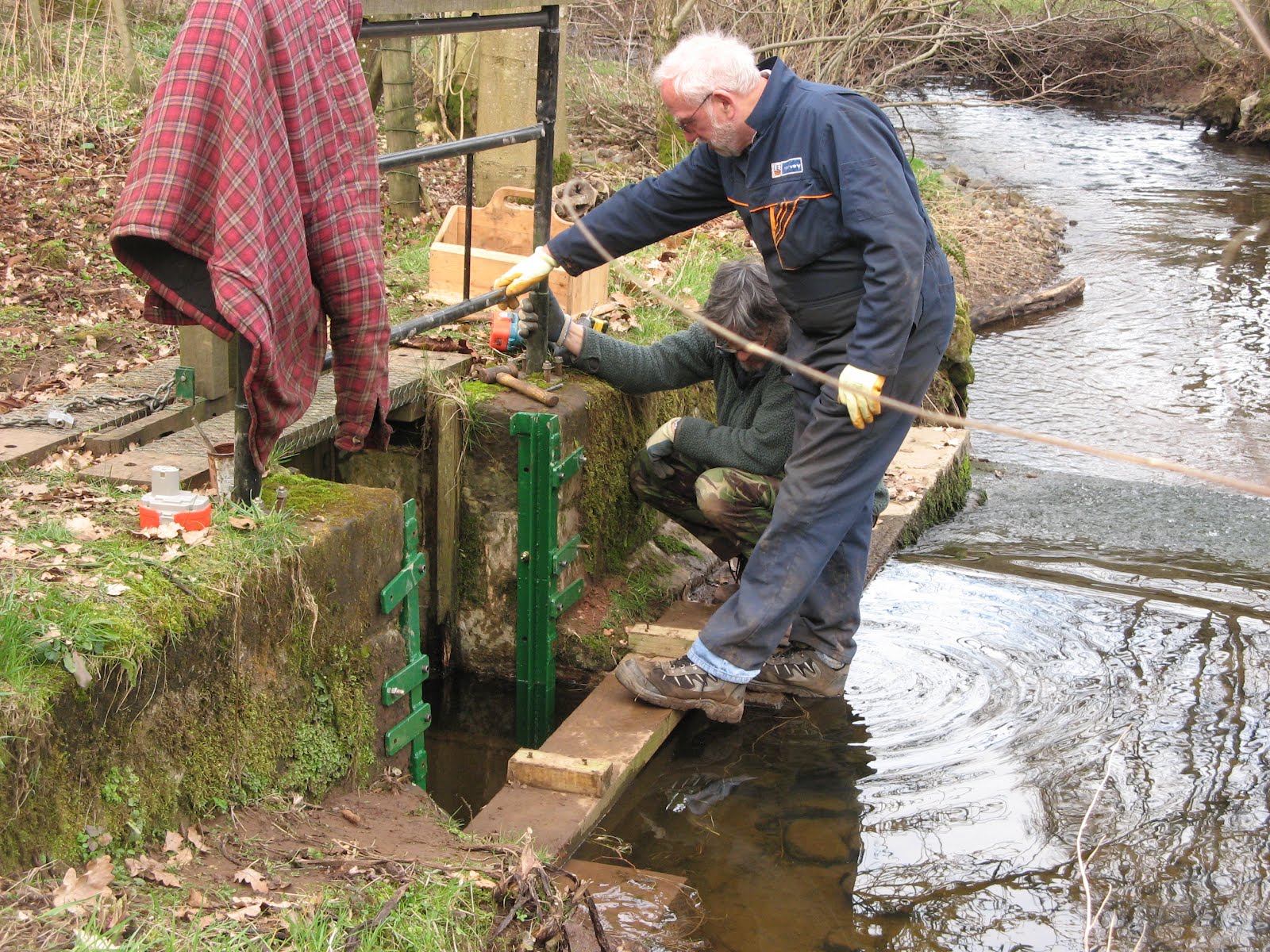
George cleans the steps
Our new man came today for his first day. George brought his own pressure washer, so after we had arranged a lot of hoses and mains connections he set about clearing the green slime from the cobbled path, fences and steps.
The cobbles see the light of day!


He then moved on to clearing all the vegetation off the launder piers so we can repoint them when launder rebuilding time comes. Between us we managed to get most of the green stuff off the cobbles under and beyond the launder, too.


The frame for the new trash strainer

Richard and Ray install the frame

Working in his home workshop, Richard has built the fixed frame in which the weir trash strainer will slide. The frame is welded from mild steel bar, and is to be bolted directly onto the inner surface of the take-off channel, and secured by flat bars bolted to the weir-side face of the stonework.


Last week he and Ray painted it, and today they fixed it to the weir stonework. The hope is that larger items will be carried over the weir by the water flowing across the strainer. The trash strainer measurements are to be taken once the frame is in place.

In the process, they found that the second weir is accessible at this time of year, due to the low vegetation, and also found an old mine truck abandoned in the river bank. It looks as though it had been filled with stones and used to reinforce the bank.


The old quarry wagon

The second weir

Tuesday, 28 February 2012

Repair of the No 2 stone nut (March 2011)

Some more pictures from the past - this time the ones Richard took when the no 2 stone nut was being repaired.

The stone nut has a square central hole which sits on a square taper mounted on the stone spindle. This hole had worn badly with use and would no longer engage properly on the taper. As the stone nut is a historical artefact, it was not acceptable to simply re-metal the edges of the hole. Instead we decided to make two steel plates to sandwich the stone nut and cut accurate squares in each of them. Fortunately the nut has four holes through which we could pass lengths of studding to holdthe whole thing together.


On the bench left to right:
the stone nut, the spindle taper, the two steel discs


The bottom disc is threaded for the studding, because the lifting mechanism pushes it up from below and nuts would be in the way. There are lifting rings that can be attached above the top nuts.

The two discs with bolts.
The discs were cut by a local engineering firm but
close inspection shows the laboriously filed out corners


When all was ready we suspended the assembly from a beam to check the strength of the lifting rings. They were OK!

You can see the wear on the original stone nut surfaces.

Pictures for the sluice repair

When we repaired the main sluice, I didn't have pictures available for much of the work (see blog for June 2010). This brings things up to date by including some pictures from Richard's camera.

The first shows the new sluice valve control assembly
which was fabricated in Richard's garage from steel.


The second shows the control assembly
mounted on the new sluice board.


Richard working in the sluice to fit the new control

Tuesday, 21 February 2012

Overhauling the shelling stone drive

Today we dismantled the drive to the No 1 shelling stone as the first stage in repairing the stone nut to make it run true. At present it is worn, and so will not sit level on its taper, leading to its damaging the cogs on the spur wheel. As we have dismantled this stone before we felt we probably knew what we were doing!

The stone lifted before
removing the rhynd

The first step was to lift the runner stone using a chain block suspended from a beam directly above the centre. We first lifted the tentering beam using a car jack so that we could post a strap from the edge to the eye of the stone. We then used a second, smaller, block to pull the stone back towards the wall. We propped it against the wall, where it was very stable; however we left a chain block attached as a "belt and braces".


The stone nut separately supported


Then we removed the rhynd, bearing top cover plate and bearing bottom adjusting plate and drove the wooden bearings out downwards. We tied the stone nut to screws in the bearing using rope, and fixed another rope between a chain block and the stone spindle.


With the tentering beam fully lowered and the bottom bearing box removed, we were able to lower the stone spindle out of the stone and take it to the workshop, followed by the stone nut. We removed the wedges and took the taper off the spindle. We now need to measure up carefully and have the 2 discs made to sit the stone nut firmly on the taper.