Friday, 28 November 2025

Replacement of the Weir


 It has been quite an exciting year at Acorn Bank Watermill.

There is a general movement to remove weirs, as they are an impediment to wildlife in the river. We were fortunate to have our weir Grade 2* listed, so it couldn't be removed without lots of permissions. However, it was badly undercut and eroded, and we were concerned that it might collapse in a storm.


Over the past couple of years we have been working with the National Trust's award-winning Riverlands team and eventually a scheme was developed to remove the weir and replace it with a series of cascades and pools. Instead of the river level dropping over the 4 metres of the weir, it would fall along 45 metres of rapids.

There were a lot of permissions needed and a lot of finance had to be identified, all of which was done by Rebecca and the Riverlands team.In August the work was carried out. Something between 500 and 700 tonnes of rock were placed in the river and the old weir was demolished.

Relief  -it works. We may even have slightly more water than before. The pictures below give some idea of the size of the task.


Trouble with the footstep bearing


 For the second half of our milling season we have been worried about a large oil leak from the footstep bearing.  As soon as milling finished we lifted the spur wheel and its shaft to remove the bearing.

It turned out the problem was with the leading that held the bearing block in its cast outer case. The casting is very tatty, several large holes and generally quite porous to molten lead  - and oil! The leading seems to have broken up, allowing oil to run over the side of the bearing and leak out through the holes. At least it wasn't broken or worn right through.

The first picture shows the parts after the old lead had been sweated out, and the second the whole thing beautifully reassembled.


Friday, 19 January 2024

 The Second Wheel Project


Acorn bank watermill originally had two waterwheels (actually there are three positions where wheels may have been, but there is some doubt whether there were ever more than two at a time). The first wheel, a pitchback, was restored with the mill in 1990 and is the one we use to drive the stones.  The second, overshot, one had been taken out of milling service in the early 1900’s and used to provide power to a nearby gypsum mine. It was not restored with the mill and half the shrouds were missing or too badly damaged to reuse.


In early 2020 it was agreed with the National Trust that we might try to restore it, but lockdown meant that came to nothing. We have recently resurrected the project. As the mill is a grade 2* listed building, we needed listed building consent from the local authority and Historic England (HE). HE were enthusiastic about our proposal and consent was granted in January 2023.  Work has now started.


The 3-d printed pattern
The new shrouds
  

A fortuitous visit by a member of Lancaster University’s Engineering Department gave us a good start. They had the idea that using modern technology to produce a casting pattern for new shrouds would make a good project.  They duly took away a good shroud, scanned it, tidied up the scan and 3-d printed a pattern for us. We took the pattern to a foundry and 6 new shrouds have been cast and now just need drilling.


At the end of the milling season we had scaffolding erected in the wheel pit so we could make progress with the modification of the water feed to drive the second wheel.  The old deflector on the end of the launder, that ensures the momentum of the flowing water doesn’t act against the wheel’s motion, has been removed.  Various beams have had to be reduced so the new water channel runs level and a start has been made on building it.

Reducing the depth of a supporting beam

Fitting the first board of the new channel


Thursday, 20 January 2022

Modifying the grain chest

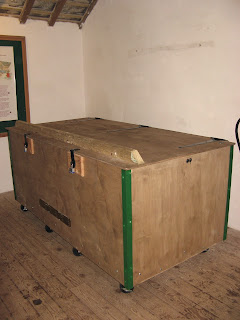
The Houghton Mill grain chest


When we started milling back in 2011, we pinched the idea for a grain storage chest from this picture I took at Houghton Mill in Cambridgeshire.

Our grain chest

Note that it is aluminium lined to deter rodents, as is ours.  We built ours out of plywood with substantial angle iron corners and internal timbers.
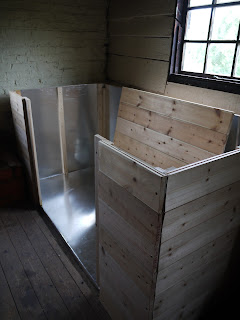
Our chest differed in one important aspect - we built it without the front opening. I think this was probably for strength, but it did mean that hauling sacks of grain or boxes of milled flour out was very bad for our backs.  It was made worse by the fact that the internal timbers restricted the height so that 2 stacked flour boxes wouldn't slide the length of the chest.

So we set about improving things. We took the two internal timbers out and reduced their height to enable boxes to slide, replaced them, and cut a central door in the front. It closes against aluminium angle at the sides and slots into 2 bits of angle aluminium making a channel at the bottom. The door is then held in by 2 bolts.
Our modified chest


We thought it was a good days work


Monday, 20 September 2021

A 10th Anniversary Party!


 Yesterday we had a small gathering at the mill to mark the 10th anniversary of the date when we first milled flour at Acorn Bank, following its 70 years of silent deterioration.

Guests included the former manager of the Acorn Bank property and members of the present visitor reception and gardening staff, volunteers past and present and their partners, and local shopkeepers who stock our flour. That's me in the whites just left of centre.

We had messages of support from several important and knowledgable people who couldn't be with us:

Jamie Lund, the National Trust archaeologist who has been a great friend to us sent his best wishes and commented:


I can hardly believe that it is a decade since you first ground flour at the mill.  This is amazing to me in two ways, firstly that ten years have passed, and secondly, that a building that was simply a collapsed ruin back in the 1980s would have a chance at such a worthwhile second life.


Martin Watts, national mill expert, said:

Hopefully your Trust will ensure the survival of Acorn Bank Mill both as a working mill and a visitor attraction. Your invitation is much appreciated and were it not for the distance I would have been pleased to attend. 

and Nick Jones sent his best wishes for the next ten years. Nick was for almost 40 years the owner and miller at Little Salkeld Watermill just a few miles from here, former chairman of the Traditional Corn Millers Guild and the really helpful neighbour who helped us set up flour milling and gave us the basic training in milling.

Thursday, 8 April 2021

Back at last


After a year of enforced neglect, the mill is now in action once again. 

The financial problems the National Trust suffered as a result of the pandemic left them unable to support the reopening of the mill. The mill volunteers offered to set up an independent charitable trust to lease the mill from NT.  Much to our surprise and delight they agreed and the mill is now operated by Acorn Bank Watermill Trust, registered charity no 1193320.

When we started to look at the deterioration, the cobbled mill yard was more than knee deep in weeds, mill moth had made merry wherever they could find a milligram of flour, wasps had made several nests in the roof and the place was filthy. The leat needed clearing and many of the wooden wedges in the machinery had shrunk and needed refitting, replacing or reinforcing.


Our volunteers put in several weeks of scrubbing, disinfecting and weeding to ensure we were ready to start milling for the Easter weekend.

We had a new delivery of a tonne of Paragon wheat from a new supplier safely stored in the grain bin.

We also had new flour bags featuring a lovely line drawing of the mill by Victoria Mandale.

The pandemic has meant that people were much more likely to want to use contactless payment methods so we also acquired a card reader.

In spite of not being allowed to have visitors in the mill due to social distancing rules we got off to a flying start selling a number of bags of flour each day of the Easter weekend.

We have also managed to place stocks with local shops and hope we can increase the local public's knowledge of the mill's existence as well as the Trust's income. We are looking for more volunteers and aim to operate on more days to show the mill to more visitors.

These are exciting times!


Tuesday, 17 March 2020

Mothballing the mill for the pandemic

We hoped it wouldn't come to it, but we have been told that all volunteering activity is suspended until further notice. A number of us had turned out for a meeting with the manager, so we spent a couple of hours cleaning out  the tun, hoovering the stones and putting it all back together in a hopefully rodent-proof state.

 Cleaning the stones                                                       and filling the groove

Because our stones are on a mezzanine floor, and the French burrs extend under the upper floor, we had to build the tun so that it separates around its middle - otherwise we could never lift it clear of the stones. We built it from tongue and groove boards and never thought to fill the remaining groove at the bottom of the top half. It proved an excellent hidey hole for mill moth.

So, while we had it apart, we took the opportunity to put some wood filler in in the groove.

Wednesday, 5 February 2020

Improving the mesh of the gears

Recently, when milling, we had noticed that the machine tended to slow down once per revolution of the waterwheel and pit wheel. Initial investigation showed that this was because the pit wheel was moving into closer contact with the wallower, to the extent that the beam carrying the top end of the upright shaft was moving.
A millwright we spoke to suggested that the pit wheel, which is cast in 2 halves, might be oval due to casting shrinkage. If so, it will always have been like that, so something else must have changed.  Once we shut down for the winter, we carried out some detailed measurements. These showed that, while there was some movement, it was nowhere more than 15mm - really no more than you can expect from these castings.
We tried a range of possible solutions to improve the mesh. Re-centring the pit wheel on the main shaft proved to be very difficult - the wedges that hold it in place were put in dry and had since swollen and were very tight.  Readjusting them would be a huge job, and removing and refitting the pit wheel was ruled out for the same reason.
We then tried to tilt the pit wheel slightly on the shaft. Our measurements had shown that there was a slight tilt as well as eccentricity. Again the tight fit made this very difficult.
Eventually we decided that the simplest solution would be to raise the wallower by a few millimetres. We achieved this by lifting the whole upright shaft out of its bearing and inserting a steel plate under the bearing before reassembly. A trial running (but not milling) under water power suggested that there had been considerable improvement.
Time will tell!
Bill and Neil working on the wallower

Thursday, 19 December 2019

Our value as Millwrights

Back in 2011, when we had first got the mill to produce flour again, we submitted an application for the Marsh Heritage Award.  History (including this blog) shows that we actually won the award.

Part of our successful submission was the statement "By their efforts they have re-established a tradition of milling and millwrighting at Acorn Bank."  Since then we have continued to develop our skills and increase our experience.

I was therefore very interested recently to discover the Heritage Crafts Association (President HRH The Prince of Wales) which publishes lists of endangered crafts.  Millwrighting is listed as Critically Endangered (see https://heritagecrafts.org.uk/millwrighting/) as there are so few practitioners.

That means, as far as I can see, that we old volunteer millwrights are ourselves suitable subjects for preservation by the National Trust!

Monday, 27 May 2019

Hunting for the cause of the hunting

We had been noticing that when water, and therefore power, is short the mill speed varies, slowing down once per revolution of the waterwheel.

Eventually, careful observation showed that the problem was that the angled gear teeth on the pit wheel, which shares its axle with the waterwheel (visible at the left of the upper picture and just seen over Neil's right shoulder in the lower) were not engaging at a constant height with the matching angled teeth on the wallower (showing just over the beam in the upper picture and half visible at centre right of the lower picture).

With the wallower higher, the coupling is slack.  When the wallower meets the pinwheel lower, there is considerable pressure exerted due to the angled gear faces.  The top of the wallower appears to move from 1cm below the top of the pinwheel to 2cm above.

Clearly something has run a bit out of alignment.  We made an attempt to help matters by twisting the pinwheel slightly on its axle and repacking the wedges.

This weekend there has still been some hunting, but we've had a bit more water so it has been less of a problem, so not sure if we have really improved it.

Work on the third pair of stones

The third runner stone lifted
 While we are waiting for the go-ahead to restore the second waterwheel, we decided to overhaul the moving parts of the drive for the third pair of stones (out of 4).

This involved the usual process of lifting and supporting the runner and removing the bearing (strips of wood) from the cast iron fitment in the bedstone.

This time we go on from there and remove the drive shaft, take the bottom bearing out and take out the wooden tentering beam.  This is mounted in a cast iron box set into the wall, and that was in a scruffy condition, so that had to come out too.  Here is Dave Freak cleaning it up with a wire brush prior to giving it a coating of Waxoyl.

The box was then fixed back in the wall with lime mortar, and the beam re-inserted and hung from the tentering bar.  The final picture shows Richard and Peter fixing the box.


Thursday, 4 April 2019

Continuing work on the second waterwheel

The second wheel in 1981
 As can be seen from the 1981 picture, the waterwheels suffered considerable damage when the mill was neglected before that date.  Some of the cast iron sections of the shrouds fractured when the spokes rotted and collapsed.

When the building was restored in 1990 the first (upstream) waterwheel (seen in the background of the picture) was repaired and restored, but the shroud sections of the second wheel were removed and stored.

Since the mill was upgraded from a Grade 2 to a Grade 2* listed building last year, work on reconstructing the second wheel has been restricted to conserving the shroud sections and ensuring they will fit together.  We need Listed Building Consent to continue with the restoration.

However, it now looks as if we may have found the means to begin the application for permission, under the auspices of a historic building consultant, Paul Lewis.

In the interim period, one of the sections has been lost, so we have set about designing jigs and templates to allow a new one to be fabricated.  The first picture shows the template for the main piece of the shroud, the others show the use of an existing section to construct a jig so that the various channels which hold the boards can be tack welded accurately in position.


Tuesday, 21 August 2018

The model wheel to encourage coin donations!

Today I finally completed the model waterwheel, which is designed to encourage kids to pester their parents for coins to drop in.

The wheel is very free on its bearings, and even a 5p coin will turn it. The whole is protected by a perspex cover - I had a lot of fun cementing that together. The coins fall in and strike a bell, so there is a very satisfactory series of clunks followed by a "ding"!


Tuesday, 3 July 2018

Update on progress

A while since I posted, so here is a little update.


Lifting the main wheel shaft
The volunteers were in mob-handed today.  One group raised the waterwheel shaft so that the wet-side bearing could have its annual inspection and re-greasing.  The previous week they had worked on the mill side of the shaft and the main vertical shaft re-packing wedges that were creaking having come loose in the dry hot weather.


Peter continues to cobble the yard, now working on the last little corner in the heat of the day!  It has been exhausting and back-breaking work.


We have also had to put a board under the slates on a further section of the roof to protect the flour sieve from stuff (bat droppings, dust, dead spiders) falling in the flour.  A couple of us finished fitting, varnishing and silicon sealing the boards.

 Work on conserving the parts of the second wheel continues while we await the formation of a proper fully authorised Project to begin to reconstruct it.

The renowned mill expert Martin Watts has carried out a second survey (the first was in 2010) and presented his conclusions in a report which will form the basis of the Mill Conservation Management Plan as it sets out our conservation philosophy (eg approach to mill-wrighting techniques) as well as commenting on the proposed programme of work.

Saturday, 7 October 2017

Starting on the second waterwheel

There is a main shaft in its bearings which formed part of the second waterwheel.  There are also a number of pieces of the shroud (cast iron rim) of the wheel, but some are missing and several are broken.  Restoring the wheel will be a challenge, but we have started by cleaning and preserving the shroud pieces, ready for trying to repair some of the broken ones.  We will have to fabricate replacements for badly damaged or missing ones.

Anyway, here are some photos of the work in progress.  Sorry, I can't persuade Blogger to show the third pic the right way round!


Some of the cleaned shrouds
David and Chris clean the rust off
The makers mark on a shroud piece
Stalker Bros, Penrith

Work continues - the jigger box

We're having quite a busy season, milling and selling a good amount of flour.

In between we have been working on restoring a drive to the "jigger box", a mechanical sieve that was once powered by belt from the stone shaft for the third pair of stones.  These were driven from the second waterwheel.  Unfortunately we don't have a second waterwheel (but see the next post) but we have the stone shaft and the belt pulley.  We have been able to connect up some belting from there via an intermediate shaft to a new shaft connected to the jigger box.


The pulley on the stone shaft
The jigger box and new shaft
Our first struggle with belting!
We've then fixed a motor intended for an invalid carriage to the top of the stone shaft.  Powered by a 12V battery it will drive the jigger box in an imitation of its original way via the belting.


Thursday, 27 July 2017

Some positive feedback


I know I haven't posted much for a while, probably because there haven't been any major developments.

However, we received this postcard from a satisfied visitor, and I thought we should share it.

Friday, 22 July 2016

The flour sieve - final version

Well, we obviously had to do a bit of work on the flour sieve.  For one thing it was too fast on the drill, so Richard adapted a washing machine gearbox, taking out a stage of speed reduction.  For another, it needed to be easier to use, so we built a trestle to mount it on, with a shelf underneath for a flour box.

This time it really seems to work, a bit noisy though!


Tuesday, 21 June 2016

Mechanical benchtop flour sieve

Over the past few weeks we have been working on a machine to take some of the backbreaking effort out of hand sieving our flour.  We always sieve the meal because we haven't yet managed to prevent whole grains from ricocheting across the top of the stone and ending up in the product.  Up to now the flour bagger has had to shake a circular stainless steel sieve by hand, OK for small quantities but desperately hard work when there is 30kg to process.

The mechanical sieve consists of two wooden boxes, the inner one holding a sheet of perforated stainless steel mesh, agitated by a cam one side of the outer box and returned by sprung pushers the other side.  We can turn it by hand, but also by using a variable speed power drill

Today it finally became possible to try it out and, while it still needs some improvement, we were very pleased with the result - cue film....


Tuesday, 12 April 2016

The kiln finished - as far as we're able to go!

The first rows of tiles

It has taken several weeks to fit the kiln tiles, with Richard doing most of the work and everyone else running errands (fetching things, drilling holes etc) for him.  He has had to work on a board over the steel t-bars, the tiles themselves are not strong enough to stand on. To make things more difficult, some of the tiles are 12 inches square, and some are 31 cm.


The finished kiln floor
In any case. we only have about 55 tiles, and we would need 144 to cover the whole area.  As there isn't a complete layer, it was especially important to fix them to the bars.  We made a number of clamp brackets, fixed by a bolt through the existing holes in the tiles.  We decided to fit them to give a sort of cut-away view of the kiln. Here you can see the final installation.  As an electrician is due to fit some additional lighting, we have put signs up to warn him about the fragility of the tiles!


Other jobs today have included tightening the wedges in the pit wheel and main shaft, carrying on cobbling the yard, painting doors and mending the plant sales wheelbarrow for the gardeners!  Also a team of volunteers from Sizergh have been clearing out our headrace - thanks, all!